
TL;DR: Absolute Love does not approve families with a gender preference, because choosing a child’s gender can mean longer waits, can be derailed by prenatal mistakes, and can place an extra burden on adoptees. Families are encouraged to examine their own gender expectations so they can love the child they parent for who they are.
If you’ve decided to adopt, you have likely received a giant stack of paperwork to fill out to get the process going. Can anyone relate?!
Among that paperwork is a worksheet asking you to select your “preferences” for the child you are looking to adopt. Those preferences guide the language used in your home study, as you are approved to adopt a child with specific age, race, medical and social history, and gender.
There is often very little education or conversation around these preferences beyond the worksheet. However – that one little checkbox regarding “gender” on it that may have huge implications for your adoption journey and for your child.
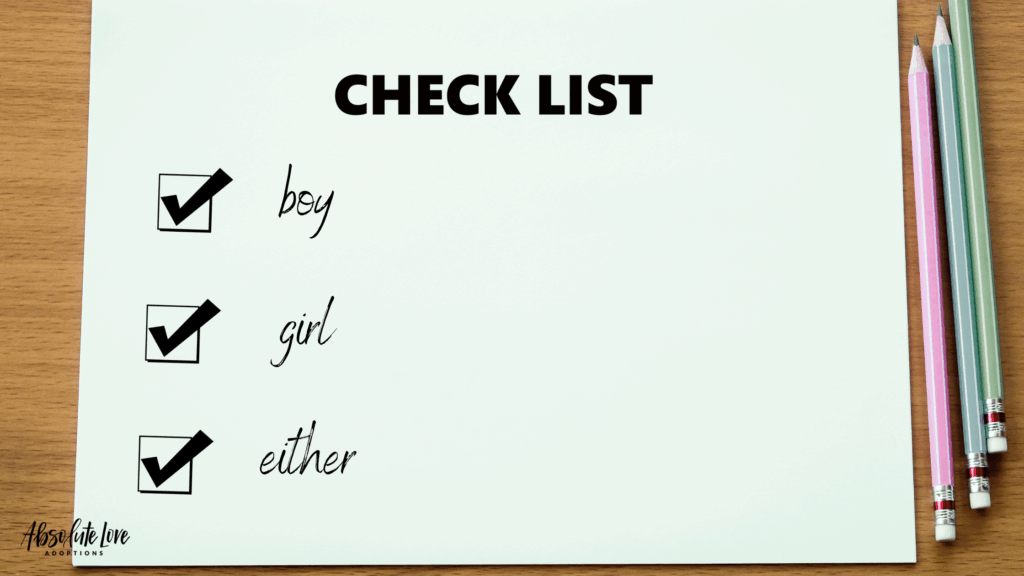
Some agencies will support a family’s decision to specify gender preferences. Others, like ours, do not approve a family with gender specifications.
We believe gender preference can be unethical, and has a potential negative impact on the adoptee - the person at the heart of this adoption.
WHY?
There’s a couple of pragmatic reasons:
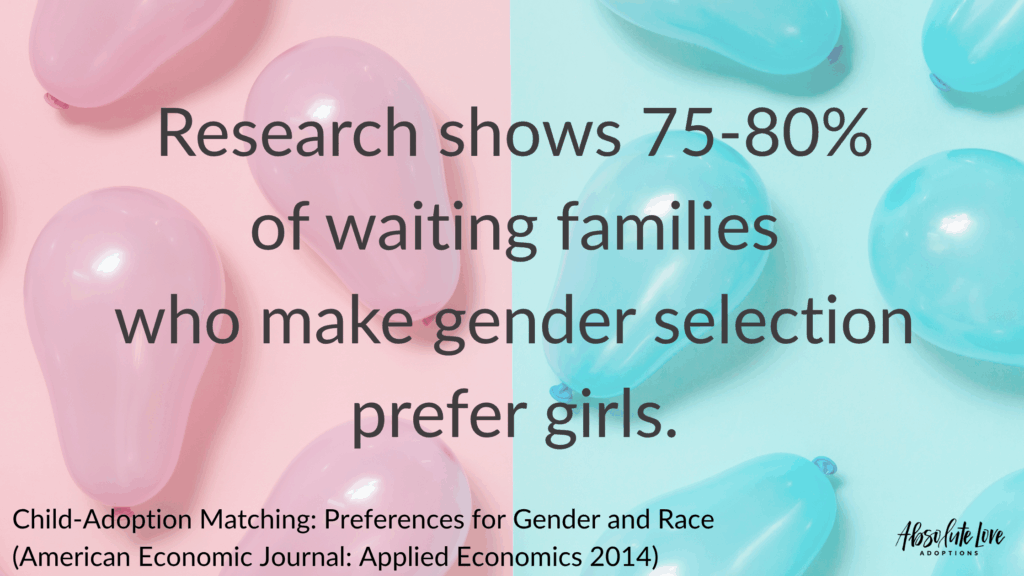
- Longer wait time. If you choose a specific gender, you’ll probably be waiting longer. Narrowing your choice to only 50% of the population means you’re drastically reducing the number of potential opportunities you’ll see.
- Statistics. In private infant adoption, there are far more families waiting to adopt than children placed for adoption. The reality is a large percentage of families who start the process will not be successful, simply because of the odds. While it’s difficult to get a hard and fast number, there is overwhelming agreement in the adoption space that there are far more families waiting to adopt than there are children being placed for adoption.
- Mistakes in prenatal care. Sonograms are not a perfect science, and are sometimes incorrect. The reality of this happening to you is not far-fetched.
There are also ethical reasons:
- Mistakes in prenatal care: Let’s say you’ve matched with an expectant mom and baby who you believe to be a girl. For months, you’ve built a relationship and grown to love this unborn daughter. You have the nursery set up, and are living in daydreams of your life with a daughter. The birth day arrives, and everything is perfect. Delivery is smooth, mom is healthy and safe, and a perfect, healthy baby boy arrives. What do you do? Do you love this child any less? Do you say “no” to parenting this child because they aren’t the girl you expected? What happens if you walk away from the placement? This creates a wound for a birth mother if the family she grew to know and trust says “no” to her and her child at delivery. She would have to go back to a pile of unknown families and do the intensely emotional and time-consuming work of finding another family for her child. Her trust would be shattered. Her confidence would be broken. All because a family says “no” to her child for being the “wrong” gender.
- An adoptee’s separation trauma and their lifelong task of integrating a sense of self: Adoption is the act of separating a child from their mother. This separation trauma can impact an adoptee’s mental health, social relationships, identity development, sense of belonging and general wellness across their lifespan. Adult adoptees commonly express feeling like they had to meet the expectations their parents had when “choosing them” through adoption, or like they tried to “be the best adoptee” so they didn’t disappoint their parents. They express feeling hypersensitive to rejection, and like they never quite fit. The work of integrating their sense of self and adoption is a lifelong task for adoptees. Why add to their burden by also asking them to be the best GIRL adoptee they can be, or the best BOY adoptee they can be? Imagine carrying this load that all adoptees face, and then learning you were adopted BECAUSE you were a girl, and not a boy? This may send a message that their value in your family is related to their gender, and their ability to uphold whatever expectations you had for their lives, related to their gender.
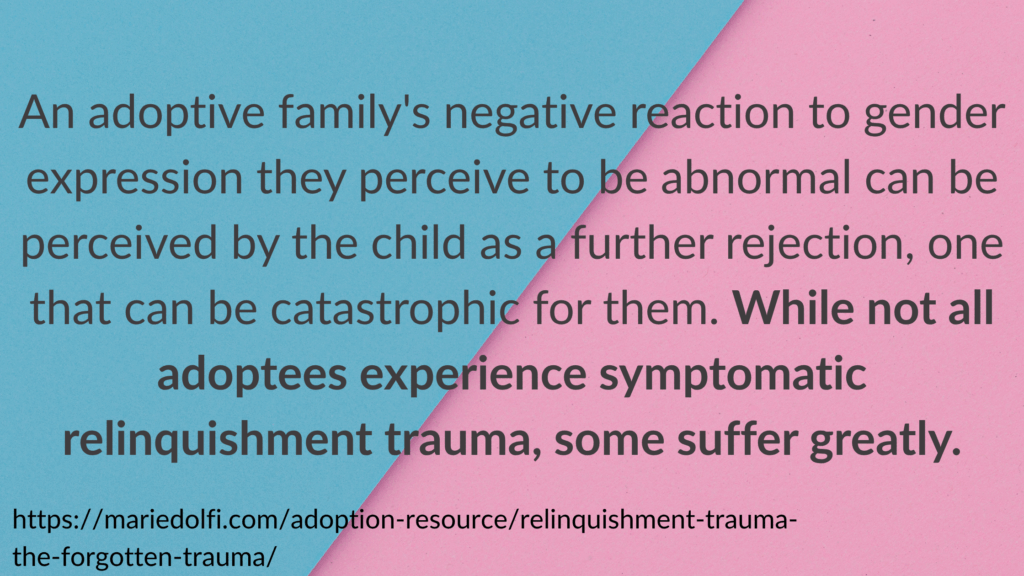
- The complex feelings around abandonment in adoptees: Adoptees often struggle with the complexities of feeling abandoned by birth families, and they sometimes internalize this as rejection. They may overcompensate, wanting to be “the good adoptee.” They may feel hyper sensitive to criticism or relationships ending. If adoptive families do not embrace their adoptee’s gender expression, the adoptee is likely to be wounded by this in ways that may not be repairable.
What expectations do you have?
Many families come to adoption with a vision in their mind of the child they are hoping to parent. These ideas have been curated over time as they’ve dreamed of parenthood. For some, the dream is an angelic little girl with bows in her hair. For others, it is a chubby-cheeked boy wearing a football onesie. These preferences often exist for biological parents, as well as those pursuing fertility treatments, too.
“A boy likes trucks and is rough.”
“A boy has short hair.”
“A girl is calm, compliant, and delicate.”
“A girl will paint her nails and have long hair.”
These biases may be influencing our preferences around parenting.
And if our own expectations around gender will be projected onto our adoptees, we are placing an additional burden on them to “be the girl we always wanted,” rather than just to be the girl they are.
CONSIDER:
How does choosing the sex of your child serve you as a parent?
Does your desire to parent exist only if you can parent a certain gender?
Where does this desire come from?
Is the goal to parent? Or is the goal to parent a specific gender?
If it is, why? What changes about the parenting experience if you have the opposite gender child?
How does your ability to be a good parent change whether it’s a girl or a boy?
If your child doesn’t uphold gender norms, how would that influence your desire to parent?
What if the girl you are hoping to parent keeps her hair short, plays sports, and marries a woman? Was your desire to parent HER, or to parent a feminine version of her?
Set down your device, and pick up a pen. Take some time to journal out your answers.
If you have a partner, discuss these questions with them.
Bonus points if you check out our guidebook that further addresses gender and other preferences:
This is important – really, really important.
We all have beliefs about who our kids may be someday. Those expectations may be subconscious, and not something we’re fully aware of yet.
As parents, our job is to bring these thoughts to light. As we enter parenthood, we will be far more prepared to care for the child in front of us, no matter who they are, if we can mindfully address our own expectations and carefully dismantle them.
Because in the end, the child we parent – regardless of gender – deserves to be loved for the person they are.
FAQs
Can adoptive parents choose the gender of the child they adopt?
Some agencies allow it, but Absolute Love does not approve families with a gender preference.
Why does Absolute Love not allow gender preferences?
Choosing a gender can lengthen your wait, can be upended when a sonogram is wrong, and can add to the burden adoptees already carry by tying their value to their gender.
What happens to a birth mother if a family declines a baby because of gender?
She would have to start over with unknown families, and her trust and confidence could be broken because a family said no to her child.
How can I examine my own gender expectations?
Journal and discuss questions such as why you prefer a certain gender, and whether your desire is to parent or to parent a specific gender. The goal is to love the child in front of you for who they are.
Take it further:
- Learn more about reasons why people may assert a gender preference when adopting.
- Listen to an interview about gender and other preferences, like this one: Are Adoption Preferences Problematic? – Modern Adoption with Erin & Jess | Podcast on Spotify
- Why do adoptive parents prefer girls?